Authentication
A reasoned opinion on authenticity.
To authenticate is to answer a question that looks simple: is this object what it claims to be? The answer calls for eye, comparison and documentation.
Who it is for
- Collectors before a purchase or after an acquisition.
- Heirs who discover objects and want to know what they are.
- Galleries and auction houses wanting an outside opinion. Edith Mbella is cited as an external expert by the Hamill Gallery.
- Museums and foundations before an acquisition or donation.
How it works
- First reading from photographs and known information.
- Direct examination of the object: form, material, patina, use, restorations.
- Comparison with reference corpora and documented pieces.
- Research into provenance and documents.
- Writing a reasoned report. See the expert report.
What you receive
- A written, argued, illustrated opinion of authenticity.
- A stylistic and cultural attribution and, where possible, a period, with its degree of certainty.
- Reservations, restorations and uncertain elements.
- A declaration of no conflict of interest.
Limits and precautions
- No absolute guarantee: the opinion is reasoned, not infallible.
- It concerns the object examined at the date of the report and may be revised if new evidence appears.
- It is not a statement that provenance is lawful: see provenance research.
- The practice may decline a file if it lacks the competence or the necessary elements. The practice declines a file when the photographs are insufficient or the object falls outside its field.
Frequently asked questions
Going further
Is the opinion of authenticity a guarantee?
No. It is a written, reasoned expert opinion that commits the practice’s expertise and states its reservations. The authenticity of an old object rests on a body of evidence.
What happens if the object is judged not authentic?
The report says so with its reasons. It may also specify what the piece is: a period copy, an object made for the market, a composite piece.
Is scientific analysis possible?
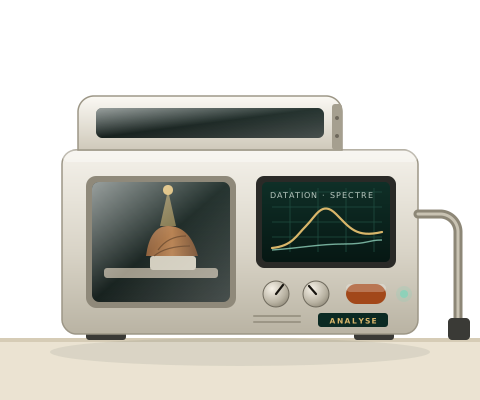
In some cases, for example for wood or materials. The practice can refer to an independent laboratory. Laboratories are chosen case by case.
How long does it take?
It depends on the complexity of the file. A timeframe is given after the first reading. Allow two to three weeks in general.
Next step
Have an object authenticated.
Describe your piece in a few lines and attach photographs: the reply is confidential.